
A midnight tremor in Chiba, felt across the Kanto plain
Shortly after midnight on Thursday, 29 October 2026, an earthquake centred in northeastern Chiba Prefecture shook Tokyo and nearby prefectures, waking residents, rattling buildings and prompting a familiar round of checks across one of the world's most earthquake-prepared regions
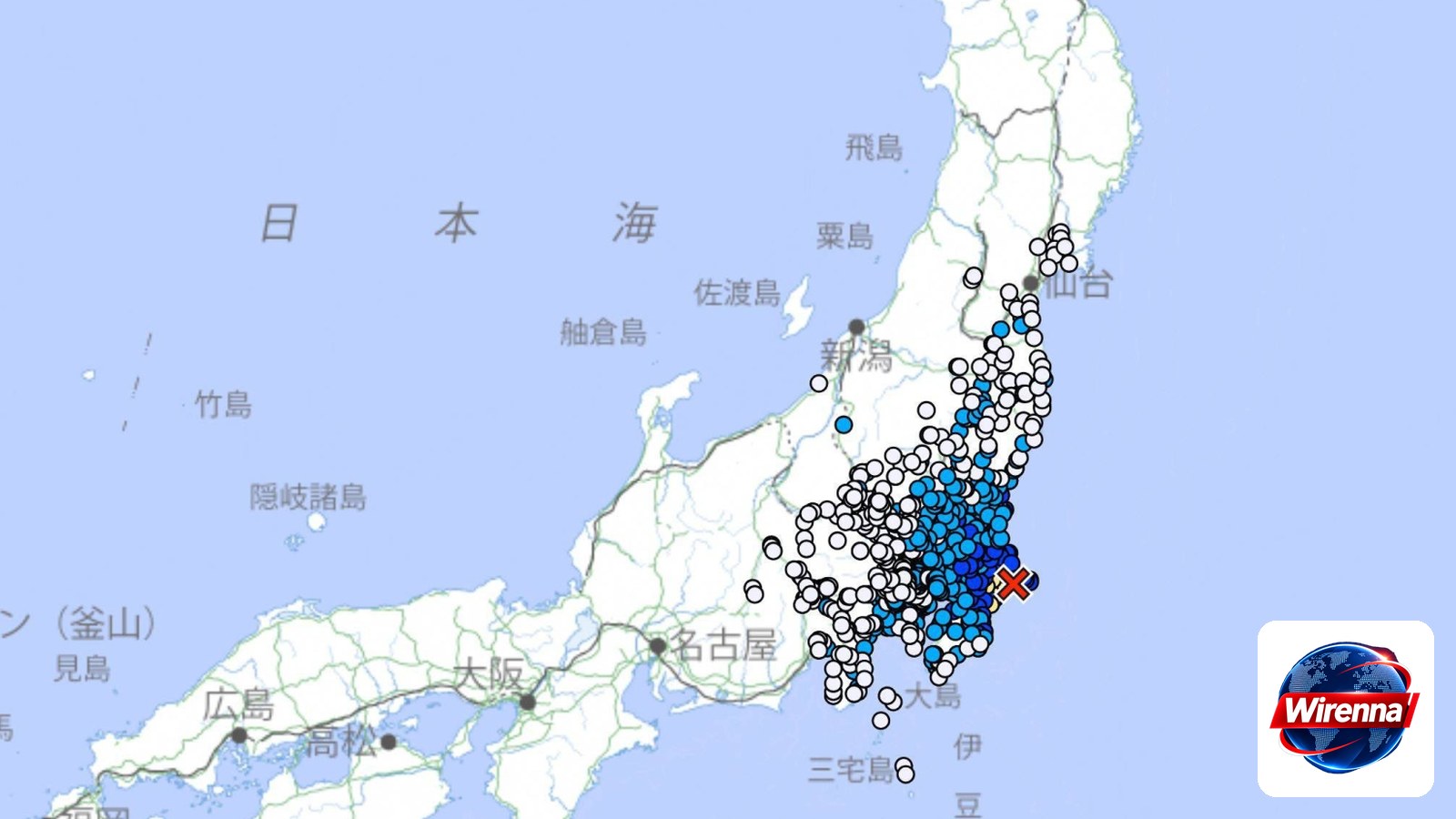
Shortly after midnight on Thursday, 29 October 2026, an earthquake centred in northeastern Chiba Prefecture shook Tokyo and nearby prefectures, waking residents, rattling buildings and prompting a familiar round of checks across one of the world's most earthquake-prepared regions. The Japan Times reported the quake at magnitude 5.4, at a depth of 50 kilometres in the town of Yokoshibahikari, with shaking reaching lower 5 on Japan's seven-point seismic intensity scale. No tsunami warning was issued.
That last point matters, and it is worth stating plainly at the start. A magnitude in the mid-5 range, at a depth of tens of kilometres inland or near the coast, does not automatically generate a tsunami, and in this case the authorities assessed that there was no tsunami risk. For residents who have lived through warnings that did require evacuation, the absence of a warning is itself important information, not a detail to be buried. It does not mean the shaking was trivial. On Japan's scale, lower 5 is a level at which many people find it difficult to walk without holding on to something, unsecured furniture can move or fall, and objects can drop from shelves. It is strong enough to interrupt sleep, work and travel, even when it does not cause widespread structural failure.
The timing and geography explain why so many people felt it. The quake struck at about 00:07 Japan time, when most households were asleep, and its effects were reported across a wide area of eastern and central Japan. Reports based on Japan Meteorological Agency data describe intensity 3 shaking in northern and southern Ibaraki, southern Tochigi, southern Saitama, northwestern and southern Chiba and eastern Kanagawa, and intensity 2 across a still wider area, including Tokyo's 23 wards, parts of Fukushima, Gunma, Niigata, Yamanashi and Shizuoka. In other words, this was not a tremor confined to one town. It was a regional event centred on Chiba but felt, at lower levels, by millions of people in the Kanto plain and beyond. Footage recorded at Narita Airport, in Chiba, captured the moment of shaking, a reminder that the region around the epicentre includes one of Japan's busiest international aviation hubs as well as dense residential and industrial areas.
Readers should also understand that the numbers in early earthquake reports are provisional. The Japan Times item, based on the initial assessment, gave magnitude 5.4 and a depth of 50 kilometres. Later Japanese reporting, citing the Japan Meteorological Agency, revised those figures to magnitude 5.5 and a depth of about 52 kilometres, with the maximum intensity of 5-minus recorded in Yokoshibahikari. A United States Geological Survey listing gave a different depth estimate, 41.4 kilometres, for a location 5 kilometres east of Asahi in Chiba, at the same origin time. These differences do not mean that any one source was careless. Magnitude, depth and exact epicentre are calculated from seismic waves recorded at multiple stations, and the calculation is refined as more data arrive. The responsible way to read an early report is therefore to treat the first figures as the best estimate at that time, and the revised figures as the product of further analysis. This article follows that approach, and it does not present a single depth or magnitude as final when the sources themselves show a revision in progress.
That distinction between magnitude and intensity is also worth explaining, because the two are often confused. Magnitude describes the size of the earthquake at its source, on a single number scale. Intensity describes how strongly the ground shook at a particular place, and it varies with distance from the epicentre, local ground conditions and building type. Japan uses its own seven-point seismic intensity scale, which is why reports speak of "lower 5" rather than a number on the Modified Mercalli scale used elsewhere. A quake of magnitude 5.4 or 5.5 can therefore produce lower 5 shaking near the epicentre and much weaker shaking, intensity 2 or 1, farther away. That pattern matches what was reported here: the strongest shaking in northeastern Chiba, progressively weaker shaking across the Kanto region, and no tsunami threat.
The broader context is geological, and it is not new. Chiba Prefecture and the wider Kanto region sit in a tectonically active zone shaped by the interaction of the Pacific Plate and the Philippine Sea Plate beneath and around the Japanese archipelago. Earthquakes of varying sizes are a regular feature of life there, and Japan has built an extensive system around that reality: a dense seismic monitoring network, an earthquake early warning system that can alert phones and broadcasters seconds before strong shaking arrives, strict building standards, regular drills and public guidance on what to do during and after a quake. The early warning process was visible in this event in livestream and broadcast records, which show an initial warning, an early epicentre estimate and then updated information as the agency refined its assessment. That sequence — warn early, then correct — is deliberate. An early warning that is slightly imprecise is more useful than a perfect warning that arrives too late.
At the micro level, the impact of a midnight quake of this size is usually practical rather than catastrophic, but it is still disruptive. People are woken suddenly. Parents check on children. Residents check gas, water and electricity, look for fallen objects and broken glass, and decide whether it is safe to stay indoors or whether to step outside. In apartment buildings, elevators may stop as a safety measure. Railway operators in Japan routinely check tracks and infrastructure after shaking above certain thresholds, which can mean delays even when no damage is found. For older residents, for people living alone and for visitors unfamiliar with Japanese guidance, a strong night-time tremor can also be frightening, and the advice in such cases is consistent: stay calm, protect yourself from falling objects, do not rush outside during shaking, and check official information rather than rumour. Early reports in this case said that Chiba police had received no damage information in the prefecture at that stage. That is an early, limited statement, not a final survey, and it should not be read as proof that nothing was damaged anywhere. It means that, at the time of those reports, no damage had been reported to that authority.
The official caution that followed is also part of the story. Japanese reporting of the agency's advice warned that earthquakes with a maximum intensity of up to 5-minus could occur again over the following week, and urged continued caution. That is standard practice after a moderate quake: aftershocks are common, and while most are smaller than the main event, they can still be felt strongly, especially at night, and they can dislodge objects already weakened by the first shaking. Residents are typically advised to secure furniture, keep a torch and shoes nearby, check emergency supplies and stay informed through official channels. That advice is precautionary, not a prediction that a larger quake will follow. Seismologists are careful to distinguish between aftershock probability, which can be estimated, and prediction of a specific future event, which cannot be made with precision.
Related news helps place this event in proportion. Japan experiences many earthquakes each year, most of them small and many of them unfelt. Events in the magnitude 5 range in the Kanto region attract attention precisely because they are felt by so many people, not because they are rare in geological terms. United States Geological Survey modelling for this event classified the risk of high fatalities and of large economic damage as low, with a green alert, but that is a modelled estimate based on magnitude, depth, population exposure and building vulnerability, not a count of what actually happened. About 24 million people were estimated to have been exposed to some shaking, according to that modelling, which underlines why even a moderate quake in this region becomes a national news item. The population exposed is large, even when the shaking in most places is light.
What should readers watch next? First, any revised official assessment from the Japan Meteorological Agency, which will settle the magnitude and depth figures and confirm the aftershock pattern. Second, any later damage or injury reports from local authorities, which may emerge after daylight inspections. Third, any transport or infrastructure updates, which are often the most visible day-after consequence of a night-time quake. None of those follow-ups should be assumed in advance. The verified facts at this stage are narrower, and they are sufficient: a moderate earthquake struck northeastern Chiba shortly after midnight on 29 October, it was felt widely across the Kanto plain, it reached lower 5 intensity at its strongest point, and no tsunami warning was issued.
For a country that lives with seismic risk every day, that combination — widely felt, locally strong, but without a tsunami threat and without early reports of serious damage — is a reminder of both vulnerability and preparation. Buildings, warnings and public habits are designed for exactly this kind of event. The test is not whether a quake happens, but whether information reaches people quickly, whether they know what to do in the first minute, and whether the systems that check infrastructure afterwards work without panic. On the evidence available so far, the information system did what it was designed to do: warn, update, and advise caution.
Source
Source: Japan Times
Read the original: https://www.japantimes.co.jp/news/2026/10/29/japan/society/earthquake-chiba-kanto-10290007/